Gaza's Winter Plight: Expectant Parents Face Deluge in Displacement Camp
As winter's first heavy rains descended upon the Gaza Strip, they brought not relief, but a renewed catastrophe for families already displaced by two years of conflict. For Samar and Abdulrahman al-Salmi, residing in a fragile tent within a Deir el-Balah displacement camp, the downpour marked a devastating setback, particularly with Samar's imminent delivery.
Awakened by torrents of water surging through their makeshift shelter, the family found their living space transformed into a muddy pool. The ground beneath them disappeared under the deluge, joining a chaotic scene across the camp where other displaced individuals frantically tried to salvage belongings and bail out water.
A Mother's Anguish and Ruined Hopes
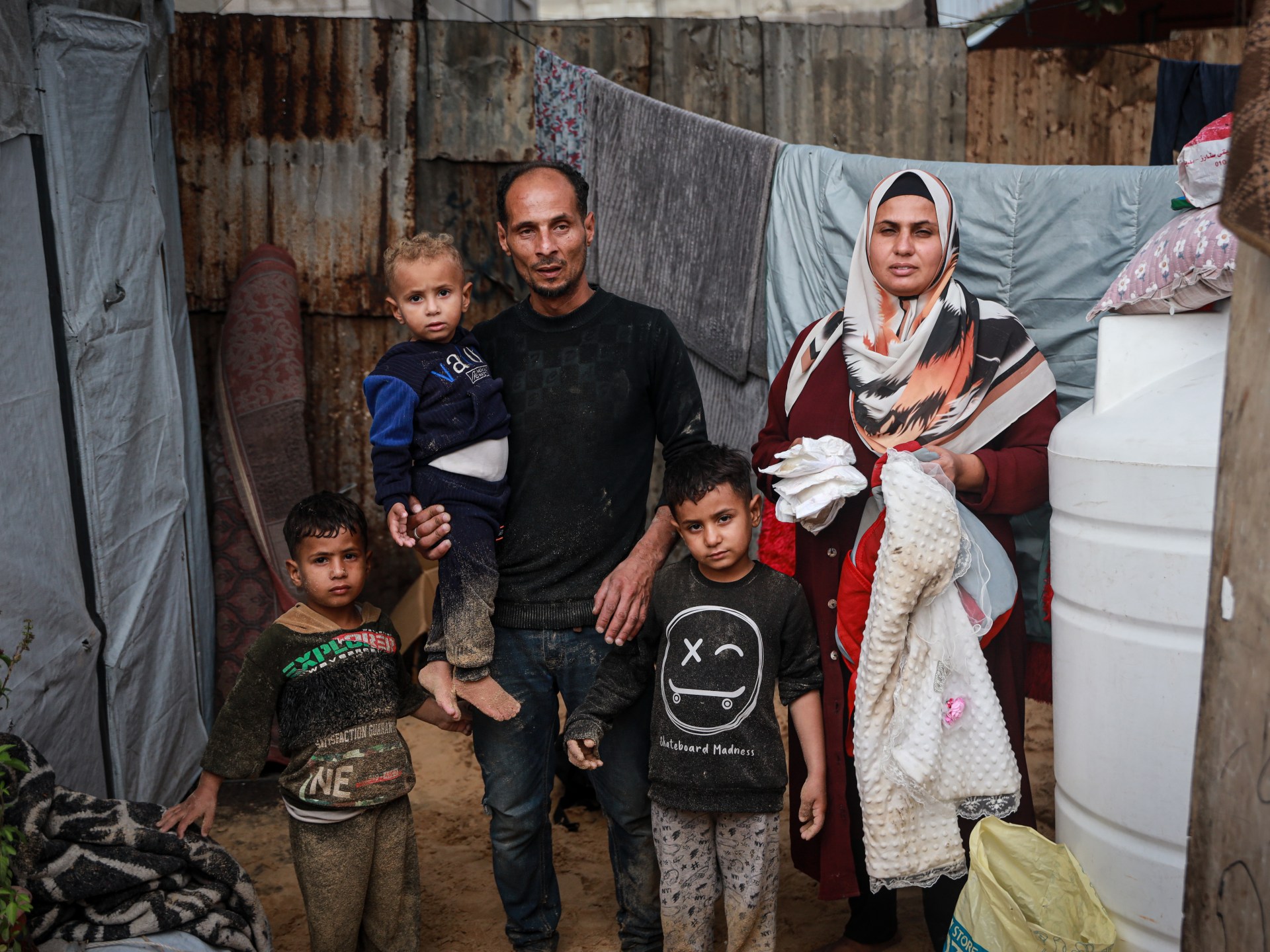
For 35-year-old Samar, every moment counts. Her due date is approaching fast, and the items meticulously prepared for her newborn daughter were submerged and ruined. "All the baby’s clothes were soaked in mud, as you can see," she recounted, lifting tiny, stained garments. "Everything I prepared – diapers, milk formula – was lost."
Samar, her husband, and their three young children share a flimsy tent, close to her mother and siblings, all uprooted from their home in Tal al-Hawa, southwest Gaza City, due to the ongoing conflict. Her voice heavy with despair, Samar expressed her overwhelming distress: "There are no words to describe how I feel. My mind is freezing. How can I welcome my baby girl into such conditions?"
While Samar grappled with salvaging what little remained, her husband and brothers battled the invading water, shoveling sand into the inundated areas. Mattresses, clothing, and essential items lay scattered, sodden, and unusable. Even the baby's hospital bag, placed in her mother’s tent for safety, became a casualty of the sudden flood.
Overwhelmed, Samar questioned where to even begin: "Should I focus on my children, whose clothes are covered in mud, needing warm baths? Or attempt to dry mattresses in this biting cold? Or prioritize preparing myself for childbirth at any moment?"
A Father's Helplessness Amidst Despair
Abdulrahman al-Salmi, 39, initially struggled to articulate his feelings, consumed by the arduous task of patching up their tent. He eventually shared his profound sense of helplessness. "As a father, I’m unable to cope," he confessed. "I try to hold our life together, and it collapses elsewhere. This is our existence during and after the war; we find no solutions."
He vividly recalled the distressing morning call from Samar as he headed to his first day at a new barbershop. "She was crying, screaming, and everyone around her was screaming," he remembered. "She told me, 'Come quickly, the rain has invaded our tent from every direction.'" Rushing back, he found their tent resembling a "swimming pool," his family shivering, and neighbors desperately bailing water. "The rain feels like the final blow," he added, tears welling up. "We've struggled since the war, and now this."
The financial burden on Abdulrahman is immense. Essential baby items, once affordable, now command exorbitant prices due to severe shortages. Diapers that cost $4 now sell for $26, and milk formula is $21. With everything ruined, his despair deepened.
Lost Dignity and Endless Displacement
Both Samar and Abdulrahman yearn for their past life in Tal al-Hawa – their warm, clean apartment, a place of dignity and peace. "Now, our apartment, our building, our entire neighborhood is destroyed," Samar lamented. "All our family homes are gone. We have no choice but to live in tents."
Their greatest fear is bringing their baby girl into such an inhumane environment. Samar, scheduled for a C-section, will return directly to the tent. She confessed a profound regret about getting pregnant amidst the war, recalling the comfort of past deliveries. "Any mother in the world would understand my feelings now," she stated, emphasizing the sensitivity of late pregnancy and the postpartum period.
Their three children—Mohammad, seven; Kinan, five; and Yaman, three—bear the brunt of their plight. Shivering from cold, without adequate clothing, and repeatedly falling ill, they recently required hospital visits for insect bites. "The older boy couldn’t sleep from stomach pain," Abdulrahman shared. "There are no blankets... nothing."
Aid organizations have long warned about the impending winter catastrophe for Gaza's displaced, especially given the strict Israeli ban on construction materials and caravans entering the Strip. "A tent is not a solution," Samar asserted. "It’s unbearable in summer and floods in winter. This isn’t a life. Why can’t caravans, at least, be allowed to offer temporary shelter?"
A Plea for Humanity and Home
For the Salmis, and countless others, the ceasefire offers no comfort; the "war never stopped," as Samar sees it, with daily bombings and suffering. Their ultimate desire transcends temporary fixes: "Even caravans are not a real solution; they’re temporary. We are human beings. We had homes. Our demand is to rebuild our homes."
Their immediate plea to humanitarian organizations is urgent: "We need clothes, mattresses, blankets. Everything is ruined. We need someone to stand with us. We need a place to shelter us. It’s impossible to keep living on a sheet of plastic." Abdulrahman's poignant summary encapsulates their reality: "Honestly… we’ve become bodies without souls."