President Lee Jae Myung Considers Apology to North Korea Over Past Drone Incident, Discusses Reducing US-SKorea Drills to Boost Dialogue
Dec 3, 2025
 South Korea
Politics & Diplomacy
South Korea
Politics & Diplomacy
South Korea
Politics & Diplomacy
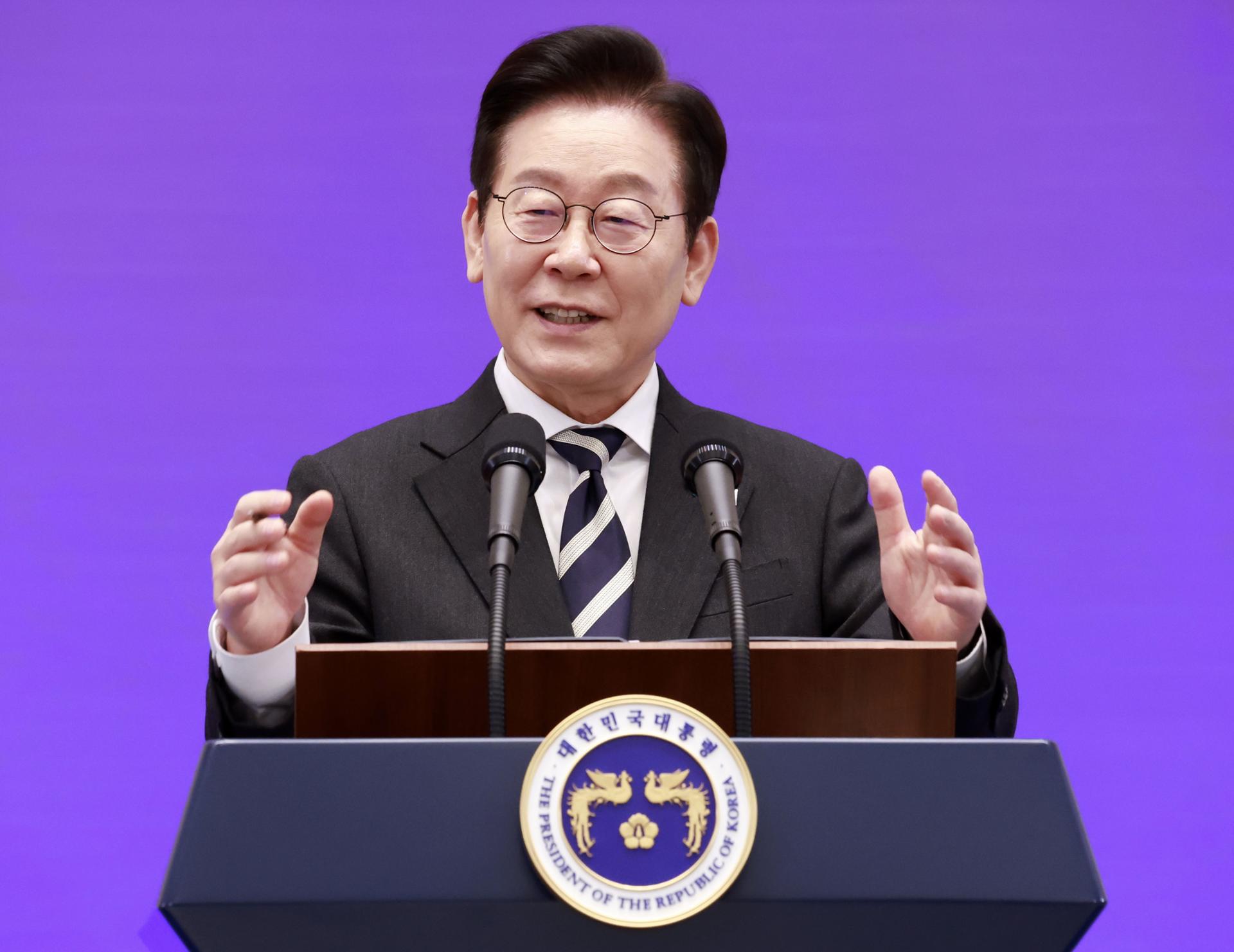
South Korean President Lee Jae Myung intends to apologize to North Korea for past drone incidents but faces domestic political challenges. He also proposed redu
President Lee Jae Myung Hints at Apology to North Korea, Open to Reducing US-SKorea Drills
During a recent press briefing in Seoul, South Korean President Lee Jae Myung revealed his intention to issue an apology to North Korea concerning the previous administration's alleged dispatch of anti-regime propaganda drones to Pyongyang. This potential gesture aims to de-escalate heightened inter-Korean tensions, though President Lee acknowledged significant domestic political hurdles.
Navigating a Political Minefield
When questioned by foreign correspondents at Cheong Wa Dae, President Lee admitted, "You are reading my mind," regarding a state-level apology for the drone incident. However, he expressed concern that such a move could ignite political and ideological conflicts domestically, potentially leading his administration to be branded as "pro-North Korea." This delicate situation is further complicated by an ongoing special counsel investigation into the drone affair, which implicates his predecessor, Yoon Sul Yeol, and some military aides. They are accused of orchestrating the drone dispatches in October last year, purportedly to provoke North Korean retaliation and establish a pretext for declaring martial law.
Reopening Stalled Channels
President Lee characterized current inter-Korean relations as "so sealed that not even a pinhole remains." He stressed the necessity of Seoul initiating unilateral confidence-building measures to re-establish communication channels with Pyongyang.
Strategic Flexibility on Military Drills
In a significant move, President Lee also indicated a willingness to discuss the potential scaling down of contentious joint South Korea-U.S. military exercises. He views this as a strategic lever to facilitate renewed U.S.–North Korea talks. "If it is needed to build momentum for dialogue, and if it serves as a strategic lever for the United States, we can discuss it," he stated, affirming his commitment to acting as a "constant facilitator" for negotiations. He underscored Washington's greater influence over Pyongyang's decisions, noting that North Korea perceives the U.S., not South Korea, as the primary actor capable of providing credible security assurances. Nevertheless, he asserted Seoul's imperative to foster an environment conducive to talks, asserting this as vital for South Korea to remain a principal in shaping the Korean Peninsula's future.
Commitment to Nonproliferation and Robust Defense
Addressing queries on deterrence and nuclear policy, President Lee reaffirmed South Korea's unwavering commitment to nonproliferation. He stated that Seoul has "no intention of stepping outside the framework of a nuclear-free Korean Peninsula." He clarified that issues like uranium enrichment, spent-fuel reprocessing, and the acquisition of nuclear-powered submarines do not violate nonproliferation norms, as they do not entail nuclear weapons development.
President Lee confidently highlighted South Korea’s conventional military capabilities, asserting they are more than sufficient to deter North Korea. He pointed out that South Korea's defense spending surpasses North Korea's annual GDP and that its military ranks among the top five globally, even without factoring in U.S. forces stationed on the peninsula. Despite this strength, he concluded by emphasizing the critical need for sustained efforts to reduce tensions and rebuild dialogue pathways to prevent the current stalemate from becoming permanent.
By news
8 months ago
No cameras found for this country.