Germany's Merz Secures Pension Bill Amid Coalition Revolt, Raising Doubts on Leadership & Economic Reforms
Dec 5, 2025
 Germany
Politics
Germany
Politics
Germany
Politics
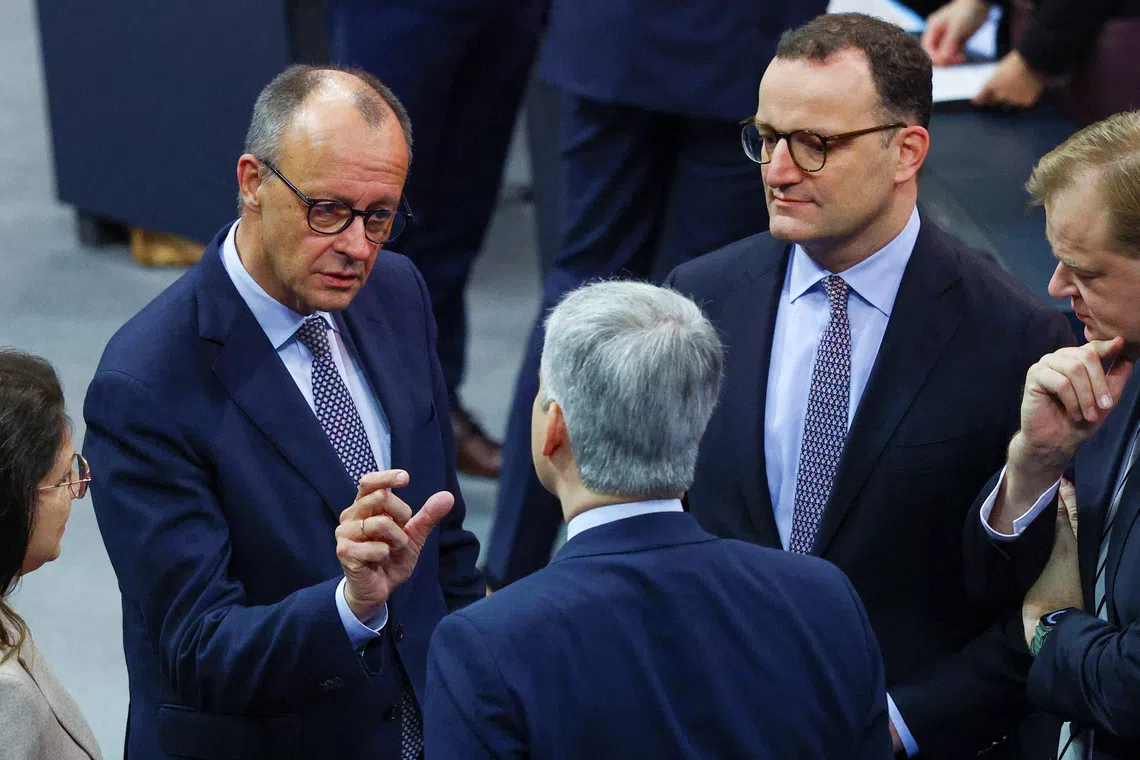
German Chancellor Merz secured a vital pension bill despite internal conservative revolt, exposing his leadership weaknesses. Doubts grow over the coalition's a
Germany's Merz Navigates Pension Bill Amidst Leadership Scrutiny
German Chancellor Friedrich Merz recently navigated a tense parliamentary vote, narrowly securing the passage of a critical pensions bill. Despite the victory, the incident has cast a spotlight on his perceived leadership fragilities, emerging just seven months into his tenure. The legislation, earmarking approximately 185 billion euros for pension spending over the next 15 years, passed the 630-seat Bundestag with 318 votes. Its approval came without needing the eleventh-hour support offered by the left-wing opposition, yet the pre-vote uncertainty itself was telling.
The close call underscored Merz's struggle to assert authority over his diverse coalition, comprising conservatives and the centre-left Social Democrats (SPD). This internal strife fuels concerns about the government's capacity to enact vital reforms for Europe's largest economy and to bolster Germany's long-underfunded military. Political scientist Johannes Hillje characterized Merz as a "weakened victor," noting that the debate "exposed the limits of his authority," making reliable governance challenging.
Remarkably, seven conservative lawmakers voted against the bill, and two abstained, an unusual display of dissent within the chancellor's own ranks.
A European Pensions Flashpoint
The pensions bill itself aims to maintain pensions at 48% of the average wage until 2031, preventing a relative decline. This measure was a cornerstone of the ruling coalition's formation agreement in May, particularly championed by the SPD. However, the youth wing of the conservatives, commanding 18 votes, vehemently opposed it, arguing that it perpetuates a financially unsustainable system burdened upon future generations. Given the coalition's slim 12-vote majority, this internal rebellion made the bill's passage highly precarious until the final moments. The far-left Left Party even offered to abstain to ease the vote for the government, citing a desire to protect pensioners.
This scenario reflects a broader European challenge: aging populations and tightening public finances are transforming pensions and generational equity into significant political battlegrounds. Economists largely criticize the German bill, with Carsten Brzeski of ING suggesting it ignores demographic realities and exacerbates the fiscal situation, as the government "still would like to live in a never-ending present."
A Track Record of Political Stumbles
Merz's chancellorship, his first time holding government office, began with high expectations. During his election campaign, he often criticized the infighting that plagued his predecessor Olaf Scholz's SPD coalition. He even brokered a historic agreement for substantial spending on infrastructure and defense before officially taking office, signaling his intent to restore Germany's international prominence.
However, his own coalition has proven unstable. He became the first chancellor to require a second round of votes for parliamentary approval on his inauguration day. Later, he failed to unite conservatives behind the SPD's agreed candidate for the constitutional court, leading to another failed vote. Eurasia Group's Jan Techau observes that the government's public image as "ineffective, divided and poorly managed is becoming increasingly entrenched."
While Merz has garnered international praise for his staunch support of Ukraine, his domestic popularity has plummeted to around 25%, marking him as one of Germany's least popular chancellors. Concurrently, combined support for the conservatives and SPD has dropped to 39% from 44.9% in February's election polls, while the far-right Alternative for Germany (AfD) continues to gain traction, now leading nationwide polls at 26% and poised for significant gains in upcoming state elections.
By news
9 months ago
No cameras found for this country.