Syrian President Ahmed al-Sharaa Calls for Unity Amidst Israeli Aggression & Gaza Atrocities, Outlines Future
Dec 6, 2025
 Syria
Geopolitics
Syria
Geopolitics
Syria
Geopolitics
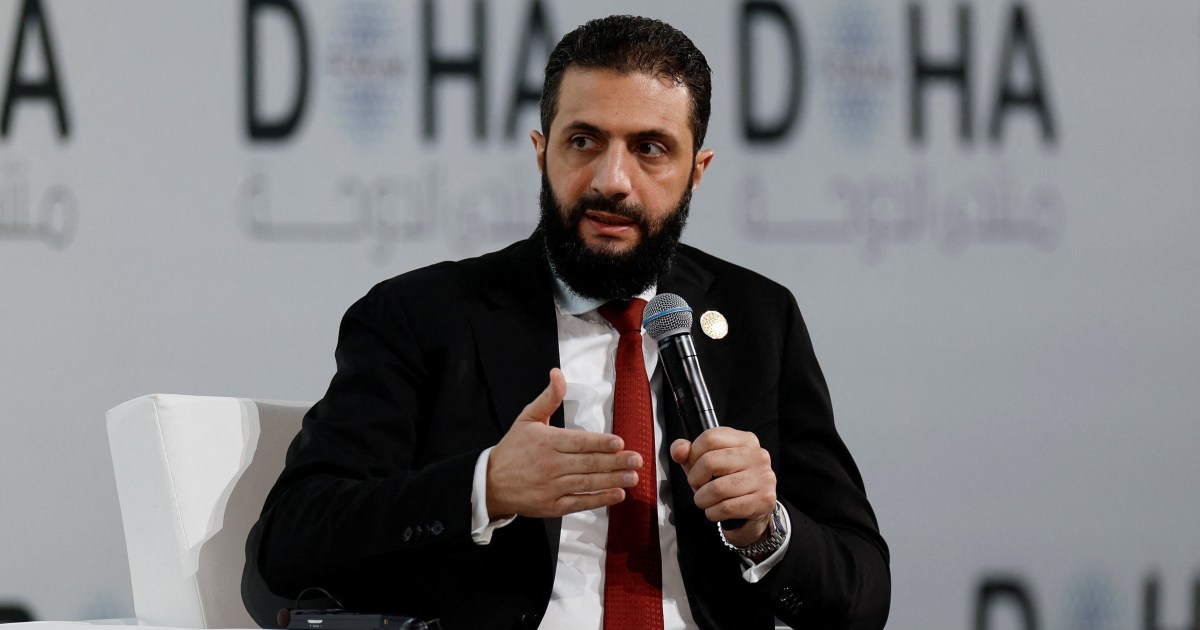
Syrian President Ahmed al-Sharaa, at the Doha Forum, accused Israel of escalating regional tensions and Gaza atrocities. He emphasized Syria's peace efforts, ch
Syria's Path Forward: Peace, Unity, and Elections Amidst Regional Strife
Speaking at the 23rd annual Doha Forum in Qatar on December 6, 2025, Syrian President Ahmed al-Sharaa delivered a powerful address, leveling serious accusations against Israel. He contended that Israel is intentionally heightening regional tensions and fabricating external threats, largely to divert global attention from the "horrifying massacres" committed in Gaza.
Al-Sharaa Condemns Israeli Aggression and Gaza Atrocities
During an interview with CNN's Christiane Amanpour, President al-Sharaa elaborated on his claims, stating that Israeli leaders habitually "export crises" to other nations. He argued they increasingly invoke security pretexts to justify expanded military actions, particularly by extrapolating the events of October 7 to rationalize their broader regional interventions. According to al-Sharaa, Israel has become a nation engaged in a "fight against ghosts."
Since the fall of the Bashar al-Assad regime in December 2024, Syria has faced a barrage of Israeli military actions. These include frequent air strikes across the country, which have reportedly resulted in hundreds of fatalities, alongside ground operations in southern Syria. Last month, Israeli forces reportedly killed at least 13 people in Beit Jinn, a town in the Damascus countryside. Furthermore, Israel has reportedly advanced deeper into Syrian territory, established numerous checkpoints, and illegally detained Syrian citizens, holding them within Israel.
Syria's De-escalation Efforts Met with Violence
President al-Sharaa highlighted his administration's efforts since assuming office to de-escalate tensions with Israel. He emphasized that Syria had consistently sent "positive messages regarding regional peace and stability," affirming Syria's aspiration to be a country of stability, not one that exports conflict, even to Israel. However, he expressed disappointment that these peaceful overtures were met with "extreme violence" and "massive violations of our airspace" by Israel. He unequivocally stated, "It is Syria that is being attacked by Israel and not the opposite."
The 1974 Disengagement Accord: A Critical Buffer
A key point of contention for al-Sharaa is the imperative for Israel to withdraw to its positions prior to the fall of the al-Assad regime and to uphold the 1974 Disengagement Accord. This historic agreement, forged after the October 1973 Yom Kippur War, established a United Nations-monitored buffer zone in the Israeli-occupied Golan Heights. Al-Sharaa cautioned that any attempts to replace this agreement, which has endured for over 50 years, with new arrangements like a buffer or demilitarized zone, risk pushing the region into a "serious and dangerous place." He raised a crucial question: "Who will protect that zone?" especially if Syrian forces are to be excluded from it, contradicting Israel's stated security concerns about southern Syria.
This stance contrasts with recent remarks by Israeli Prime Minister Benjamin Netanyahu, who indicated that a deal with Syria was achievable. However, Netanyahu's proposal was conditioned on Syrian government forces establishing a demilitarized buffer zone extending from Damascus to Jabal al-Sheikh in the Israeli-occupied Syrian Golan Heights. Al-Sharaa firmly challenged this, asserting Syria's greater right to demand a buffer zone and a pullout, given its status as the attacked party.
Forging Unity Amidst Internal Challenges
Addressing domestic concerns, al-Sharaa described Syria as experiencing its "best days," acknowledging both progress and ongoing challenges in achieving national unity. He pragmatically noted that absolute unanimity is an unrealistic expectation, even for advanced, stable nations. He attributed historical disunity to issues inherited from the al-Assad regime and highlighted his administration's policy of pardoning a large number of people and factions to build a sustainable, safe, and secure future. Furthermore, he rejected the characterization of the uprising against al-Assad as exclusively a "Sunni revolution," emphasizing that all components of Syrian society, including Alawites, suffered under the former regime's abuses.
Despite the President's vision of unity and law, Syria has regrettably witnessed outbreaks of sectarian violence this year. This includes the tragic killing of hundreds of Alawite religious minority members in coastal areas in March, with some perpetrators identified as members of the new government's security forces. Additionally, clashes between government forces and Bedouin tribes in Suwayda in July resulted in over 1,400 deaths, primarily civilians. Al-Sharaa acknowledged these "negative" incidents, insisting on their unacceptability and stressing that Syria operates as a state of law, which is the only mechanism to preserve everyone's rights.
Empowering Women and Commitment to Future Elections
Rights groups have voiced concerns regarding women's freedoms under the new government, particularly given al-Sharaa's Hayat al-Tahrir group's past restrictions on women's public participation and dress code during their rule in Idlib. Countering these concerns, al-Sharaa stated that women are "empowered" under his administration, with their rights "protected and guaranteed." He affirmed continuous efforts to ensure women's full participation in both government and parliament, light-heartedly quipping, "I believe you should not fear for Syrian women, fear for Syrian men."
Looking to Syria's future governance, al-Sharaa emphasized strengthening institutions over consolidating individual power. He committed to holding parliamentary elections within five years, following the current transition period. While acknowledging that Syria is not yet ready for immediate elections, he underscored that the principle of people choosing their leaders is fundamental and even rooted in Islamic tradition. He believes this path—commencing after the five-year transition period initiated by the temporary Constitutional Declaration in March—is the most suitable for Syria.
By news
6 months ago
No cameras found for this country.