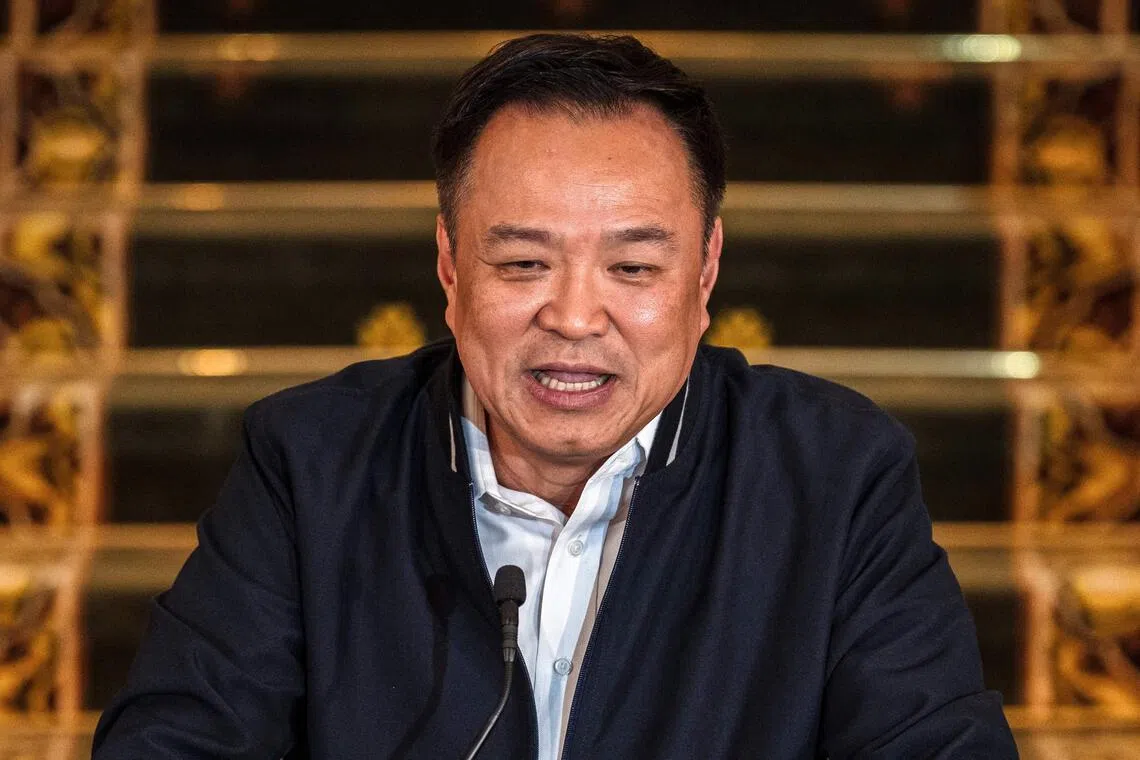

Thailand's Prime Minister Anutin Charnvirakul said there’s no plan for a ceasefire as the country reported the first civilian death from a Cambodian rocket attack after eight days of intense fighting.
PHOTO: AFP
Published Dec 15, 2025, 07:50 AM
Updated Dec 15, 2025, 07:50 AM
BANGKOK - Thai Prime Minister Anutin Charnvirakul said there’s no plan for a ceasefire as the country reported the first civilian death from a Cambodian rocket attack after eight days of intense fighting.
“There was no plan nor agreement by the Thai government for a ceasefire with our enemy as of 10pm last night,” Mr Anutin said in a Facebook post on Dec 14, after Malaysian Prime Minister Anwar Ibrahim urged the two sides to stop fighting by that time.
“Thailand stands firm with our determination to preserve, protect and defend integrity of our land and our people at all cost,” Mr Anutin said.
The premier’s comments came after the Thai army confirmed a villager had been killed by a BM-21 rocket launched by Cambodia into a civilian area in the Kantaralak district in Si Sa Ket province.
The 63-year-old was the first Thai civilian to die directly because of Cambodian attacks. Nine others have perished due to existing medical conditions since the conflict restarted last week.
The Thai foreign ministry lodged a protest with the United Nations human rights agency on Dec 14, accusing Cambodia of launching indiscriminate attacks, including on non-military targets.
A Thai soldier was killed by Cambodian shelling in the same district, bringing total fatalities on the Thai side to 16 soldiers, with 327 others wounded. Cambodia hasn’t disclosed any military casualties.
Thailand’s navy imposed a curfew from Dec 14 in five districts in the south-eastern coastal Trat province that border Cambodia’s Koh Kong province. The army previously imposed a curfew in some areas in the north-eastern Sa Kaeo province.
Cambodian Prime Minister Hun Manet on Dec 14 praised what he called the strength and unity of his country. He called on his citizens to support their “heroic army” in its mission to “protect the sovereignty and dignity of Cambodia’s territory”.
The Cambodian government on Dec 14 said Thailand had deployed a fighter jet to drop a bomb in one area.
Since last week, the conflict has left more than two dozen dead on both sides, including 11 Cambodian civilians as reported by Cambodian authorities. More than half a million people have been displaced.
Fighting resumed along the nations’ 800-km border on Dec 7, the most serious escalation since five days of intense fighting in July that was halted by a ceasefire agreement engineered by US President Donald Trump, who threatened to halt trade talks with both countries.
The new clash also derailed Mr Trump’s “Kuala Lumpur Peace Accords” signed by the Thai and Cambodian leaders at a regional summit in Malaysia in October. Mr Trump said on Dec 12 he had brokered a fresh ceasefire, but Mr Anutin denied that any agreement had been reached.
The earlier agreement laid out steps for the two countries to start withdrawing troops and heavy weapons, with Thailand set to release 18 Cambodian soldiers in its custody. In November, Thailand suspended terms of the agreement after four soldiers were injured by a land mine that the army said was newly laid by Cambodia, an allegation Phnom Penh rejected.
Mr Anutin’s hardline stance on the border conflict and nationalist rhetoric could help boost his popularity and that of his conservative Bhumjaithai Party ahead of Thailand’s general election, tentatively expected in early February.
Still, a survey taken in December showed support for him declined from the previous quarter. Mr Anutin’s government has been criticised for its slow response to some of the most devastating floods to hit southern Thailand in decades. BLOOMBERG