US Envoys Meet Putin in Moscow for Late-Night Ukraine Peace Talks Amidst European Concerns & Shifting Aid Dynamics
Dec 3, 2025
 Ukraine
International Diplomacy
Ukraine
International Diplomacy
Ukraine
International Diplomacy
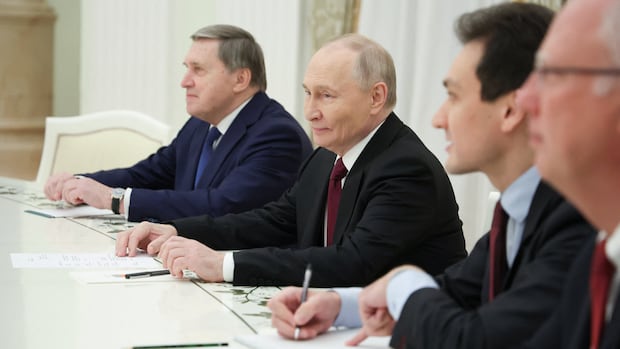
US envoys Steve Witkoff and Jared Kushner met Russian President Putin in Moscow to discuss Ukraine peace. Europe is now Ukraine's top benefactor, while Putin re
High-Stakes Moscow Summit: US Envoys, Putin Discuss Ukraine Peace Amidst Global Tensions
A high-stakes meeting between a U.S. delegation, including special envoy Steve Witkoff and former President Donald Trump's son-in-law Jared Kushner, and Russian President Vladimir Putin stretched late into the night in Moscow on December 2. The closed-door discussions at the Kremlin centered on a potential peace plan for the ongoing conflict in Ukraine, notably without the presence of Ukrainian representatives or their European allies.
Earlier in the day, Putin had rejected European peace proposals, asserting Russia's readiness for prolonged conflict. This stance complicates efforts as Ukrainian President Volodymyr Zelenskyy, currently in Ireland, indicated willingness to meet Trump again, contingent on the Moscow talks' outcome.
Kushner's re-emergence in international diplomacy follows his prior involvement in brokering the Israel-Hamas ceasefire deal finalized in October. His presence, without a formal White House adviser title, has raised eyebrows, especially given past reports of significant outside income during his initial White House tenure and recent meetings with Russian sovereign wealth fund head Kirill Dmitriev in Miami, which preceded his current involvement in Ukraine-related discussions.
Shifting Sands of Support for Ukraine
The talks underscore a notable shift in international support for Ukraine. Germany's Kiel Institute reports that Europe has surpassed the United States as Ukraine's leading financial and military benefactor. Since the 2022 invasion, European nations have contributed an estimated $167 billion US, compared to $130 billion US from the U.S. Nordic countries, the U.K., Germany, and France have significantly increased their contributions, compensating for a perceived decrease in U.S. aid. Canada has also committed nearly $22 billion in various forms of support. While the Trump administration announced a new military assistance package, the plan reportedly places the financial burden of purchasing American-made weaponry on Europe.
Trump's 'Mess' Assessment of the Conflict
Commenting on the conflict from a White House cabinet meeting, Donald Trump described the situation as “What a mess.” He asserted that the war “never would have happened” if he had been president in 2022, though he offered no specifics. Trump also reiterated a questionable claim of having ended eight wars, humorously suggesting he deserves a Nobel Prize, while expressing concern for the lives lost in the nearly four-year-old conflict.
Ukraine's Skepticism and Putin's Dismissiveness
Ukrainian Foreign Minister Andrii Sybiha criticized Putin's recent remarks, stating they demonstrate no intention to end the war and that the Russian president is “wasting the world's time.” Sybiha affirmed Ukraine's commitment to a “fair peace” and acknowledged progress made with U.S. and European partners, urging Moscow to end the conflict.
Adding to the skepticism, Ukrainian defense analyst Oleksi Melnyk of the Razumkov Centre in Kyiv expressed doubt about the talks' success, assigning them a mere “one per cent” chance. Melnyk believes Putin negotiates from a position of strength, perceiving divisions among Ukrainians, Americans, and Europeans, and thus feels no pressure to concede. He highlighted Ukrainian society's steadfast refusal to accept any terms compromising national sovereignty.
Putin's long-standing disdain for the European Union was evident again, as he blamed European leaders for obstructing a peace deal. He views the EU as hostile and subservient to the U.S., potentially deeming Ukrainian EU membership as either improbable or strategically irrelevant in his vision of a multipolar world. This contrasts with many European leaders' fears that a weak peace deal could encourage further Russian aggression. Meanwhile, both Russia and Ukraine have escalated strikes on energy infrastructure, indicating an intensifying conflict as the war approaches its fourth year.
By news
8 months ago
No cameras found for this country.