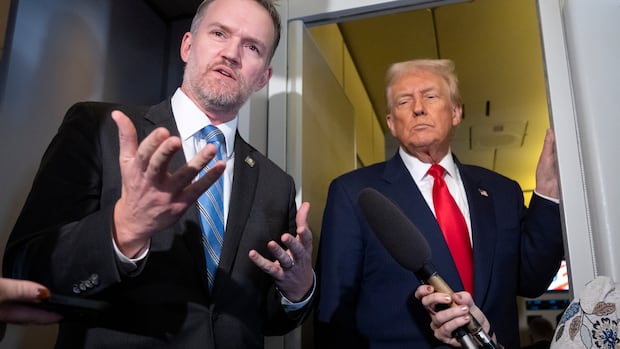
The North American trade landscape faces significant uncertainty as U.S. President Donald Trump signals his willingness to potentially withdraw from or significantly alter the Canada-U.S.-Mexico Agreement (CUSMA), even as powerful U.S. business leaders vociferously defend the accord in crucial Washington hearings. Trump’s recent statements suggest he is open to letting CUSMA expire by December 4th or pursuing new, separate trade deals with Canada and Mexico.
U.S. Trade Representative Hints at Major Changes
Adding to the apprehension, U.S. Trade Representative Jamieson Greer recently indicated that President Trump is considering withdrawing from CUSMA next year. A report from Politico and comments made by Greer in a podcast further revealed the administration's contemplation of dividing the agreement, allowing the U.S. to negotiate distinct bilateral trade deals with its northern and southern neighbors. Greer confirmed discussing this possibility with President Trump earlier in the week.
Industry Leaders Rally in Defense of CUSMA
These high-stakes discussions coincide with ongoing, multi-day hearings in Washington, D.C., where a broad spectrum of U.S. industry and business leaders are presenting overwhelmingly in favor of renewing and maintaining CUSMA. Experts, manufacturers, and representatives from critical sectors like agriculture and the auto industry are advocating for the agreement's continuation, emphasizing its vital role in North American economic stability and growth.
Neil Herrington, a senior vice-president at the U.S. Chamber of Commerce, strongly criticized the Trump administration's own tariffs on Canada and Mexico, calling them a “clear violation” of CUSMA’s foundational commitment to tariff-free trade within the continent. While defending the agreement, Herrington also pointed out areas where Canada and Mexico, in his view, have fallen short of their obligations. He specifically cited Canada's dairy market restrictions, gaps in intellectual property protection, digital services trade barriers, and even “health care” concerns, though without elaborating. For Mexico, Herrington highlighted issues in agriculture, energy, and government procurement.
Further reinforcing support, Kevin Brady, co-chair of the Coalition for North American Trade, lauded CUSMA (known as USMCA in the U.S.) as “a gold standard for trade agreements.” He urged the administration to reconsider any move to abandon the deal, asserting that it has made the U.S. “economically stronger, more secure and strategically positioned to win against aggressive foreign adversaries like China.”
Hearings Reveal Near-Unanimous Support
CBC correspondent Mike Crawley, reporting from Washington, noted that nearly 150 individuals representing every U.S. economic sector, from avocados to zinc, are scheduled to testify. Despite Trump's public musings about withdrawal, Crawley observed a striking consensus among speakers and in written submissions: virtually no one is advocating for CUSMA's demise. The testimony gathered from these hearings will be summarized in a report due to Congress by January 2nd, compiled by U.S. Trade Representative Jamieson Greer.
Presenters, grouped by sector, include legal and policy experts, agricultural interests, and representatives from business umbrella groups, manufacturers, and the automotive sector. While primarily American, a handful of Canadian and Mexican business leaders are also contributing their perspectives, particularly those from industries heavily impacted by tariffs, such as steel, aluminum, and aviation. The agreement is formally up for review in July 2026, with a set expiration in 2036. The current debate, however, suggests an accelerated timeline for critical decisions regarding its future.