
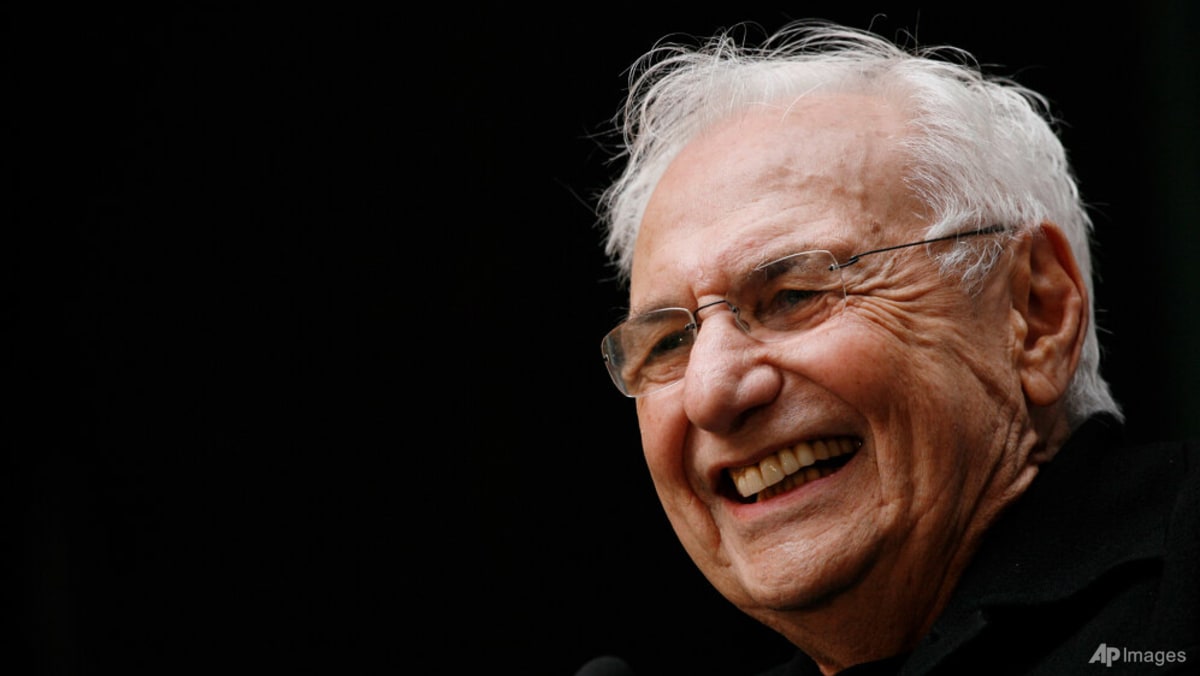
Visionary Architect Frank Gehry, Creator of Global Icons, Dies at 96
The world of architecture mourns the loss of Frank Gehry, the Canadian-born United States architect whose daring, sculptural designs redefined contemporary building, who passed away on Friday, December 5, at the age of 96. Gehry, known for iconic structures such as the Guggenheim Bilbao and the Walt Disney Concert Hall in Los Angeles, died peacefully at his Santa Monica home following a brief respiratory illness, his representative Meaghan Lloyd confirmed to AFP.
A Legacy of Form and Innovation
Gehry belonged to an exclusive group often dubbed "starchitects" – a label he famously disliked, despite his global fame. "There are people who design buildings that are not technically and financially good, and there are those who do," he remarked to The Independent in 2009, preferring a simpler categorization of his craft as a "maker of buildings."
His artistic genius was unmistakable, manifesting in complex, often whimsical designs like the glass "sails" of the Fondation Louis Vuitton in Paris. Gehry not only popularized contemporary architecture but achieved such widespread recognition that he even made an appearance on The Simpsons, all while maintaining his down-to-earth perspective on his work.
From Toronto to Global Recognition
Born Frank Owen Goldberg in Toronto, Canada, on February 28, 1929, to a Jewish family, he relocated to the United States in the late 1940s. He later changed his surname to Gehry to circumvent potential antisemitism. His academic journey took him through the University of Southern California, where he earned his architecture degree in 1954, followed by a stint in the US Army and further studies in city planning at Harvard, though he didn't complete that program.
Gehry's professional career blossomed upon his return to Los Angeles, initially working for Victor Gruen, a pioneer in shopping mall design. After a period in Paris with Andrew Remondet in 1961, he established his own architectural practice in Los Angeles the following year. The 1970s and 1980s witnessed the emergence of his most audacious and experimental designs, many concentrated in Southern California. Rooted in the avant-garde "funk" art scene, Gehry's deconstructivist and often controversial style – characterized by irregularly shaped metal facades resembling crumpled paper – defied easy classification. These visionary structures were often realized only through his pioneering adoption and mastery of computer-aided design tools, a testament to his innovative spirit. His seminal 1978 redesign of his own Santa Monica residence, featuring corrugated metal wrapped around the original 1920s building, stands as a prime early example of his distinctive approach.
In 1989, Gehry received architecture's highest honor, the Pritzker Prize.
The 'Bilbao Effect' and Beyond
Nearly a decade later, he unveiled what is widely considered his magnum opus: the Guggenheim Museum in Bilbao, Spain. This titanium-clad, limestone, and glass marvel, with its iconic curvy walls, became instantly recognizable as a Gehry creation. American colleague Philip Johnson famously hailed it as "the greatest building of our time." The museum profoundly revitalized Bilbao's ancient industrial heart, drawing visitors globally and coining the term "Bilbao effect" – a phenomenon where transformative architecture elevates a region's economy and cultural standing. The museum acknowledged, "We will be forever grateful, and his spirit and legacy will always remain connected to Bilbao."
Emboldened by this success, Gehry continued to push boundaries with subsequent projects, including the Walt Disney Concert Hall (2003), New York's Beekman Tower (2011), and the Fondation Louis Vuitton (2014). Bernard Arnault, Chairman and CEO of LVMH, expressed profound sadness, remembering Gehry as a "genius of lightness, transparency and grace." Even tech giant Facebook enlisted Gehry for a significant expansion of its Menlo Park campus, completed in 2018.
Master of Computational Design
Gehry's commitment to pushing design limits was unwavering. He embraced advanced 3D modeling software, similar to that used in aerospace, to create complex, rounded, and curved shapes that architects previously avoided due to engineering challenges and spiraling costs. This innovative approach allowed him to deliver unique structures like the Lou Ruvo Center for Brain Health in Las Vegas, with its striking, seemingly melted walls, while keeping projects financially viable. As he told The Guardian in 2019, "I love working. I love working things out."
Frank Gehry's indelible mark on the urban landscape and his fearless pursuit of architectural innovation ensure his legacy will endure for generations to come.