
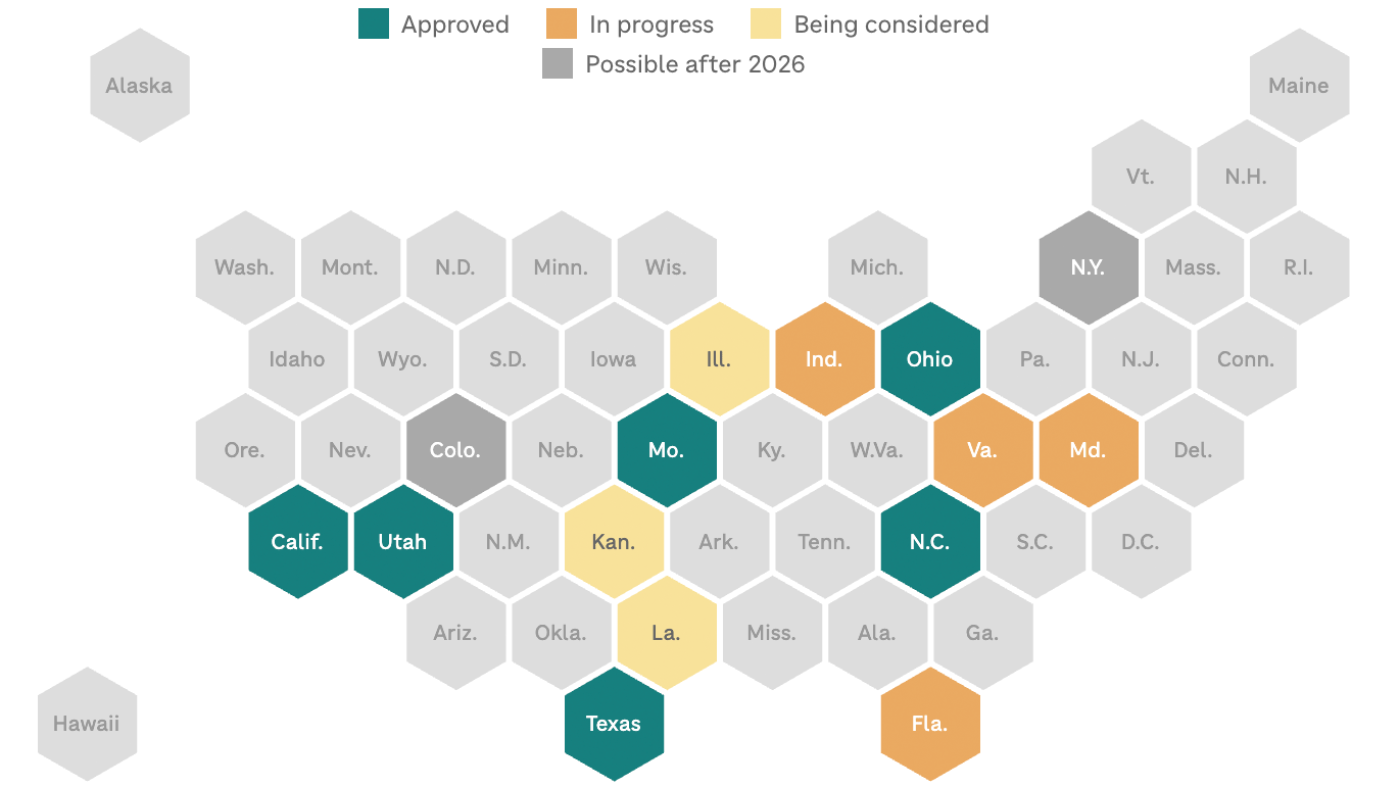
The political landscape for the upcoming 2026 election cycle is taking a definitive shape, with Republicans poised to gain a significant redistricting advantage following a crucial Supreme Court decision. Last week, the conservative majority on the nation's highest court upheld Texas lawmakers' redrawing of congressional districts, a move that could hand the GOP five additional seats in the House of Representatives. This ruling comes despite a lower court's finding that the Texas legislature likely engaged in racial gerrymandering.
The Trump-Fueled Redistricting Race Accelerates
This development marks a pivotal moment in a nationwide redistricting battle that President Trump initiated, aiming to secure Republican control of the House. A Democrat-controlled House could significantly impede the president's legislative agenda and launch investigations into his administration. With the House currently finely balanced at 220 Republican seats to 213 Democrat seats, every district redrawing carries immense weight. While the sitting president's party typically faces losses in midterm elections, the current redistricting efforts are projected to tip around 12-14 seats towards Republicans, with Democrats potentially countering by gaining about nine seats. However, numerous pending court challenges and state legislative votes mean the final tally remains uncertain.
A Look at State-Level Maneuvers
The ripple effect of the Texas decision is evident across the country. Historically, redistricting occurs early in the decade following the decennial census. However, Trump's aggressive push has ignited a flurry of activity reminiscent of the 1960s.
Texas's Contested Map
The Texas ruling follows a dramatic summer where Democrats staged a walkout for over two weeks to protest maps they argued diluted the voting power of Black and Latino communities, after Trump explicitly called for the state to favor the GOP with five seats.
California's Countermove
In response, California Democrats approved a map via a special election designed to flip five Republican-held seats in their state.
Midwest and Southeast Fronts
Indiana lawmakers are currently debating their own redistricting plans, with the state House already passing a map that could net the GOP two seats. Republicans in Missouri and North Carolina have also moved to target a Democratic-held seat in each state. Virginia's Democratic-led legislature is pushing for a constitutional amendment to facilitate redistricting, potentially yielding two or three seats for Democrats, pending another January vote. Maryland's Democratic governor has formed a commission, though the state has only one Republican-held seat to target.
Florida's Ambition
Republican Governor Ron DeSantis is pressuring Florida's GOP-controlled legislature to redistrict swiftly, aiming to swing up to five seats to their party. Despite Florida's existing laws against partisan gerrymandering and federal Voting Rights Act (VRA) protections against racial gerrymandering, a House committee has begun meetings.
The Republican Advantage in Drawing Lines
Republicans generally find it easier to redraw district lines for their benefit for several reasons. Firstly, redistricting is primarily handled by state legislatures, and the GOP holds a majority of these bodies nationwide. Secondly, many Democrat-controlled states have legal safeguards against partisan gerrymandering or mandates for independent commissions to draw district boundaries, limiting their flexibility compared to Republican-led states.
Uncertain Future for the Voting Rights Act
Further complicating the electoral landscape is the Supreme Court's ongoing review of the federal Voting Rights Act. A potential weakening of the VRA, which prohibits intentional efforts to diminish minority voting power through "cracking" (spreading minority voters across multiple districts) or "packing" (concentrating them into one district), could pave the way for more redistricting that disproportionately benefits Republicans.
The true impact of these far-reaching redistricting battles will ultimately be determined when votes are tallied in the November 3, 2026, elections.