Immigrant CDL Issues Found in 8 States: Federal Crackdown & Funding Threats Amid Deadly Crashes
Dec 15, 2025
 United States
Government & Politics
United States
Government & Politics
United States
Government & Politics
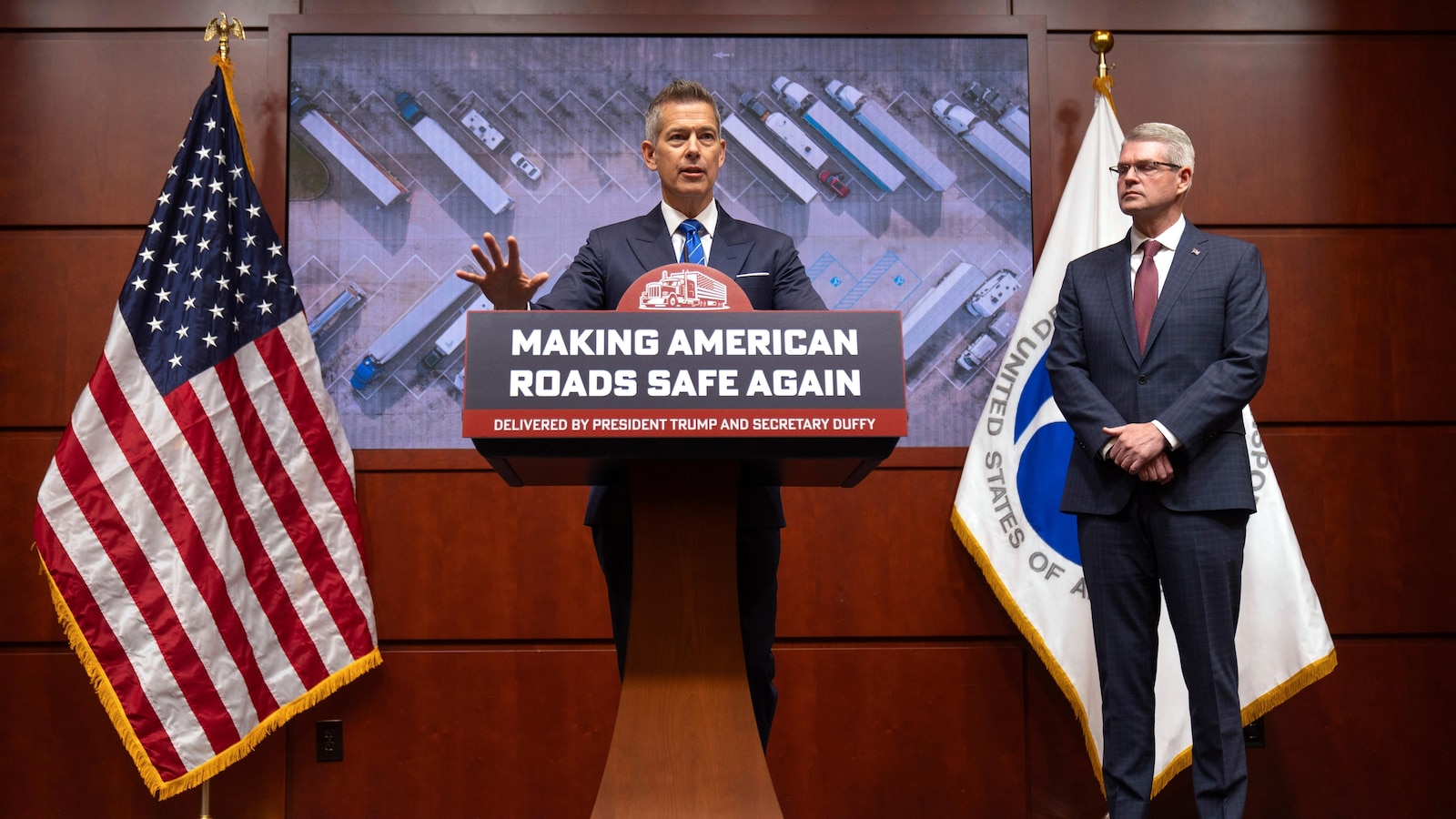
Federal probes reveal problems with immigrant commercial driver's licenses in 8 states. Issues like expired legal status and English proficiency spark funding t
Federal Crackdown Uncovers Immigrant CDL Issues Across Eight US States
The federal government has intensified its scrutiny of commercial driver's licenses (CDLs) issued to immigrants, uncovering systemic problems in eight states following a series of fatal accidents. This nationwide crackdown, spearheaded by Transportation Secretary Sean Duffy, threatens states with significant cuts to federal funding if they fail to rectify these deficiencies.
Concerns escalated after two separate deadly crashes. An unauthorized driver caused a three-person fatality in Florida in August, and another undocumented driver was involved in a fiery crash in California in October, also killing three. These incidents highlighted serious flaws in state-level CDL issuance and verification processes.
In response, Secretary Duffy proposed stringent new restrictions in September, aiming to severely limit non-citizens' access to CDLs for semi-trucks or buses. Although a court has temporarily halted these rules, the Trump administration has concurrently pushed to enforce existing English language proficiency requirements for truckers. As of October, approximately 9,500 truck drivers across the nation have been pulled off the road for failing to meet these language standards during traffic stops or inspections.
State-Specific Challenges and Federal Responses
The Department of Transportation (DOT) initially focused its investigation on California, as the driver involved in the Florida crash obtained his license there. Despite initial resistance from Governor Gavin Newsom, who defended California's verification methods, the state ultimately revoked 17,000 — a number that later grew to 21,000 — commercial driver's licenses after confirming validity issues. While this action averted the withdrawal of a substantial $160 million in federal highway funds, California did lose $40 million for being the sole state not enforcing English language requirements for truckers.
In Pennsylvania, a DOT audit revealed that a few licenses remained valid after the drivers' legal presence in the U.S. expired. Furthermore, the state allegedly provided no proof of verifying legal residency for non-citizens at the time of license issuance in four other cases. With roughly 12,400 non-citizen drivers holding CDLs or permits, Pennsylvania faces a potential loss of nearly $75 million and has been ordered to halt new issuances until a full review is complete.
Minnesota was threatened with a $30.4 million funding cut. The DOT identified licenses valid beyond work permit expiration and instances where immigration status wasn't verified. Pong Xiong, head of Minnesota's Department of Driver and Vehicle Services, stated that the state had already identified and addressed many administrative issues among the 2,117 non-domiciled commercial licenses issued, planning further cooperation with federal officials.
New York is under intense scrutiny, with federal investigators finding over half of 200 reviewed licenses improperly issued. Many defaulted to an eight-year validity period irrespective of work permit expiration, and the state couldn't verify the immigration status for 32,000 active non-domiciled commercial licenses. Instances of licenses issued with expired work authorizations were also noted, prompting the Federal Motor Carrier Safety Administration to demand an immediate, comprehensive audit.
Texas could lose $182 million due to nearly half of 123 reviewed licenses being flawed. Governor Greg Abbott has since directed the Department of Public Safety to strictly enforce English language proficiency and cease issuing intrastate CDLs to non-compliant drivers.
South Dakota faces a $13.25 million reduction. The state issued licenses that were valid too long and, notably, granted several to ineligible Canadian citizens. A key problematic practice involved routinely issuing one-year temporary paper licenses regardless of a driver's immigration status.
In Colorado, approximately 22% of 99 reviewed licenses violated federal rules, affecting about 1,848 active non-domiciled CDLs. A computer system glitch extended license validity during multiple federal database searches, and eighteen ineligible Mexican citizens also received licenses. An audit is underway, with new issuances paused, potentially costing the state $31.35 million.
Finally, Washington had problems in about 10% of 125 reviewed licenses. More critically, an internal state review discovered 685 immigrant drivers mistakenly issued regular commercial licenses instead of the required non-domiciled ones, often due to acceptance of incorrect documentation. While state officials are addressing the issues, no specific funding withdrawal has been detailed for these particular violations, although the state is currently dealing with widespread flooding.
By news
15 hours ago