Trump's Golden Dome Missile Shield Plagued by Delays, Funding Woes, and Industry Skepticism
Nov 21, 2025
 United States
National Security
United States
National Security
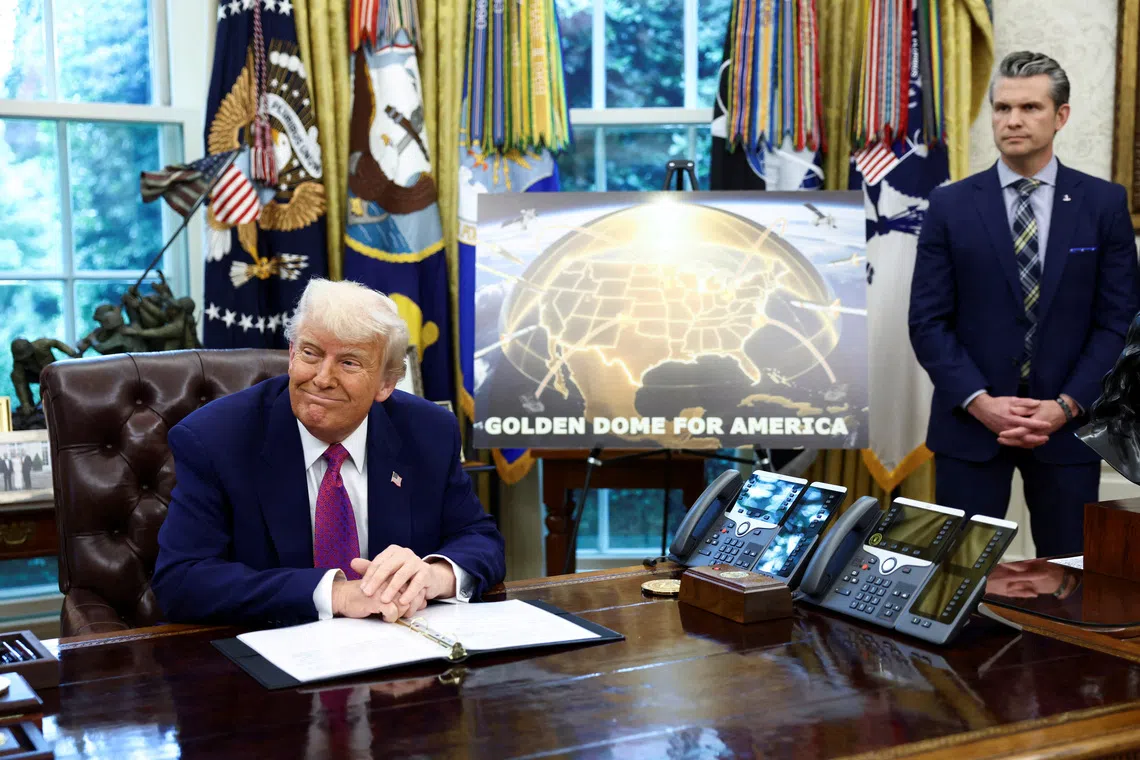
Trump's Golden Dome missile defense program faces major delays, funding issues, and contractor skepticism. A government shutdown impacted hiring, and architectu
Trump's Golden Dome Missile Shield Faces Major Delays and Funding Hurdles
The ambitious "Golden Dome" missile defense initiative, a cornerstone promise of former US President Donald Trump, is encountering significant roadblocks that imperil its projected 2028 operational date. Originally envisioned as a comprehensive shield for the continental United States, the US$175 billion program, announced early in Trump's administration, is struggling with a myriad of issues ranging from bureaucratic inertia to industry reluctance.
Bureaucratic Bottlenecks and Unspent Billions
A 43-day government shutdown proved particularly disruptive, stalling crucial hiring processes and diverting essential personnel from contract approvals, according to multiple industry and government sources. More critically, nearly US$25 billion appropriated for Golden Dome this summer remains unallocated, lacking a detailed spending plan. This financial limbo is a major point of contention and delays the program's progression from planning to execution.
Sources within the administration, Congress, and the defense sector indicate that a spending plan, initially due to Congress in late August, is now anticipated in December from Deputy Secretary of Defense Steve Feinberg. While defense contracting delays are not uncommon, the tight timeline set by the Trump administration amplifies their significance for Golden Dome. Some industry insiders fear key contracts won't be awarded by the Pentagon's internal December 31 deadline, potentially escalating costs.
Leadership Assertions vs. Architectural Uncertainty
Despite these challenges, a White House spokesperson asserted the project's visionary nature, emphasizing the collaborative effort to develop "next-generational technology." The Pentagon, for its part, affirmed its rigorous protection of the program's strategic advantages, citing adversaries' intent to exploit breakthroughs. General Michael Guetlein, Golden Dome's program manager, declined to comment, though he did submit an implementation plan in mid-November, currently under review.
However, the program's fundamental architecture, proposed in September, is reportedly still in flux and weeks away from finalization. Without a definitive architectural blueprint, an approved spending plan, or a finalized implementation strategy, Gen. Guetlein is reportedly unable to initiate contract awards, effectively freezing the initiative's forward momentum. This stagnation fuels concerns among industry experts that Golden Dome may ultimately require a much larger budget and an extended timeline. Todd Harrison, a senior fellow at the American Enterprise Institute, estimated a robust missile defense system could cost US$3.6 trillion over two decades.
Staffing Struggles and Expert Concerns
Staffing issues further compound the problems. Gen. Guetlein's office at the Pentagon is struggling to meet its headcount goal of 30 staffers and has lost a key technical director from the US Space Command. While a replacement has been identified and some missile defense experts have been temporarily brought in from facilities like Redstone Arsenal, the lack of permanent, specialized personnel is a bottleneck. Tom Karako, a weapons security expert at the Center for Strategic and International Studies, highlighted that a four-star general like Guetlein should be able to expedite matters, but "indecision at still higher levels" prevents progress.
Contractor Reluctance: The Space-Based Interceptor Dilemma
Perhaps the most daunting hurdle is the reluctance of potential contractors to shoulder the substantial upfront costs for developing Space-Based Interceptors (SBIs). These interceptors, a network of satellites designed to counter missiles from launch to impact, require significant investment. Documents reviewed by Reuters indicate that companies are expected to bear the development costs for four different SBI versions – for boost phase (two altitudes), mid-flight, and hypersonic missiles – without the typical federal government cost-sharing for such risky research.
One top defense contractor executive revealed they are unlikely to compete for the interceptor contracts due to the high costs of multi-year competitions and the risk of a future administration abandoning the program. While the Pentagon dangles lucrative production contracts of US$1.8 billion to US$3.4 billion annually and "prize pools" for testing milestones (e.g., US$340 million split for "on orbit" tests), industry executives estimate individual SBI development and testing could cost US$200 million to US$2 billion. Major players like Lockheed Martin, Northrop Grumman, RTX, and Boeing are expected to vie for other Golden Dome components once blanket contracts become available.
Glimmer of Progress: Early Warning Systems
Amidst these challenges, some progress is noted. The Department of Defense is advancing in centralizing disparate early-warning systems, crucial for detecting and tracking ballistic, hypersonic, and advanced cruise missiles. These systems, which involve intelligence gathering from satellites and ground sources, will feed critical data to Golden Dome, significantly enhancing its ability to intercept threats.
By news
11 months ago