Belarusian President Lukashenko Visits Myanmar Military Regime, Backs Disputed Election Amidst Civil War
Nov 29, 2025
 Myanmar
International Politics
Myanmar
International Politics
Myanmar
International Politics
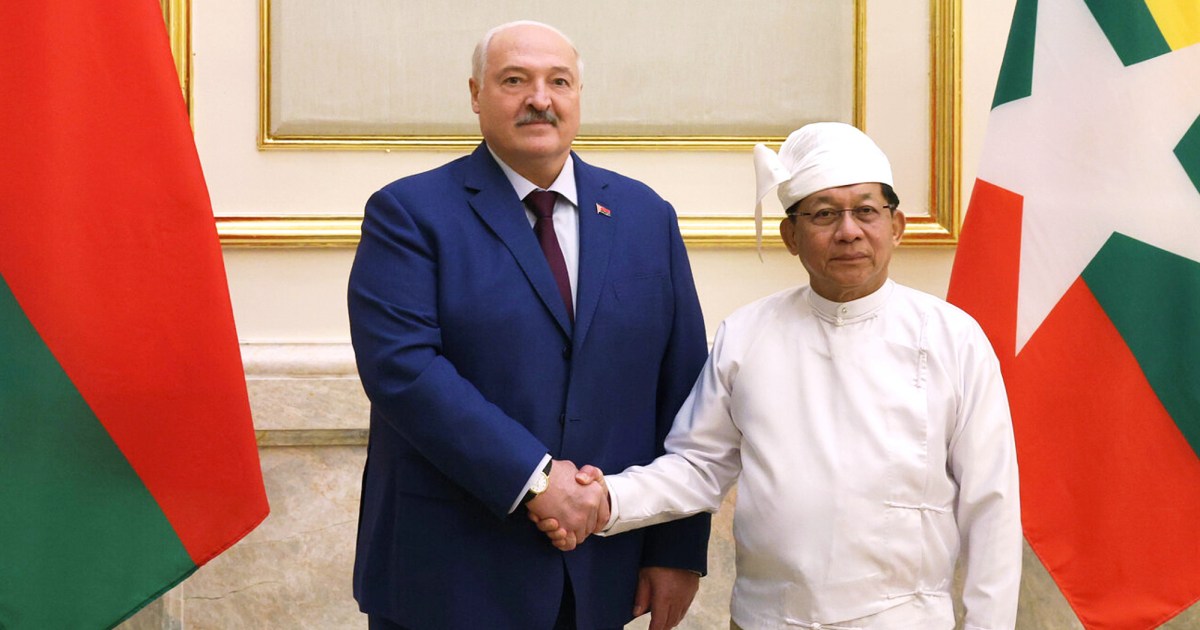
Belarusian President Lukashenko visited Myanmar, endorsing its military government and upcoming contested national election. His visit comes amidst a civil war
Belarusian President Lukashenko Visits Myanmar, Supports Military Regime Amidst Conflict
Belarusian President Alexander Lukashenko has made a significant visit to Myanmar, becoming only the second foreign leader to engage with the nation's military government since the coup on February 1, 2021. This trip, officially termed a "goodwill visit," is widely interpreted as a strong endorsement of Myanmar's military leadership, particularly as the country prepares for a contentious national election next month.
A High-Profile Reception in Naypyidaw
President Lukashenko received full state honors upon his arrival, meeting with Senior General Min Aung Hlaing, Myanmar's self-appointed de facto leader, at the Presidential Palace in Naypyidaw. Myanmar's state media hailed the occasion as "historic," marking the first visit by a Belarusian head of state in 26 years of diplomatic relations between the two nations.
Endorsing Disputed Elections
The timing of Lukashenko's visit is particularly noteworthy, occurring just weeks before the military's scheduled national elections in late December. These polls have drawn severe criticism and have been broadly condemned as a "sham" by numerous domestic and international observers. The Belarusian leader's presence is seen as an attempt to legitimize these upcoming elections, which the military government promotes as a crucial step towards restoring normalcy. Furthermore, Belarus has pledged to send an observation team to monitor the polls, reinforcing its support.
Strengthening Military and Economic Ties
Beyond political backing, discussions between the leaders also focused on enhancing collaboration in military technologies and trade. This aligns with the recently signed Myanmar-Belarus Development Cooperation Roadmap 2026–2028. Belarusian Foreign Minister Maxim Ryzhenkov emphasized Myanmar's considerable industrial potential and Belarus's expertise in mechanical engineering, particularly in agricultural mechanization, signaling future cooperative ventures.
Context of Authoritarian Rule and Civil War
President Lukashenko, who has governed Belarus since 1994, presides over a regime widely classified as authoritarian. Belarus, alongside staunch allies China and Russia, is one of the few countries that have continued to engage with Myanmar's military leaders in the aftermath of the 2021 coup.
The coup itself ignited a widespread protest movement that has since escalated into a protracted civil war, significantly eroding the military's authority across the country. Current estimations indicate that the military controls less than half—potentially as little as 21 percent—of Myanmar's territory. In contrast, ethnic armed groups and the anti-regime People's Defence Force exert control over a significantly larger portion of the land.
Elections Amidst Instability
Against this backdrop of intense conflict and limited governmental control, exacerbated by the military's dissolution of Aung San Suu Kyi's popular National League for Democracy (NLD) party in March 2023, many critics view the prospect of holding credible elections as absurd. In a move widely seen as a precursor to the polls, the military recently granted a mass amnesty, pardoning over 8,600 individuals who had been imprisoned for opposing army governance.
By news
7 months ago
No cameras found for this country.